 By
Bifacial solar panels have been getting a lot of attention lately, and for good reason: they now make up close to 70 percent of new module production worldwide. But before assuming they’re automatically the better choice over standard mono PERC panels, it helps to understand exactly where the extra performance comes from, and where it doesn’t.
The Basic Difference
A standard mono PERC panel generates power only from its front face, the side pointed at the sun. Behind it sits a solid backsheet that provides structural support but produces nothing. A bifacial panel swaps that backsheet for a second layer of glass with active cells, allowing it to capture direct sunlight from the front and reflected light bouncing off the ground from the rear.
How Much Extra Power Are We Actually Talking About
This is where things get interesting, because the numbers vary a lot depending on your specific setup. A study published just this week, comparing bifacial and monofacial systems across five different Indian climate zones, found gains ranging from 8.36 percent to as high as 27.1 percent, depending heavily on ground reflectivity and local climate. Separately, research into high albedo environments, like the sandy, light coloured soil common in Rajasthan and Gujarat, has shown bifacial panels achieving 15 to 20 percent higher yields in those specific conditions.
The key word there is conditions. Bifacial gain isn’t a fixed number; it depends almost entirely on what’s beneath and around the panel.
Where the Rear Side Actually Earns Its Keep
Rear side generation depends on something called albedo, essentially how reflective the surface underneath your panels is. White gravel typically reflects 50 to 60 percent of light, light coloured concrete around 30 to 40 percent, and white TPO roofing can reflect as much as 60 to 70 percent. Installing bifacial panels over a dark rooftop or a surface with poor reflectivity means the rear side has very little to actually capture, which significantly limits the advantage you’d otherwise get.
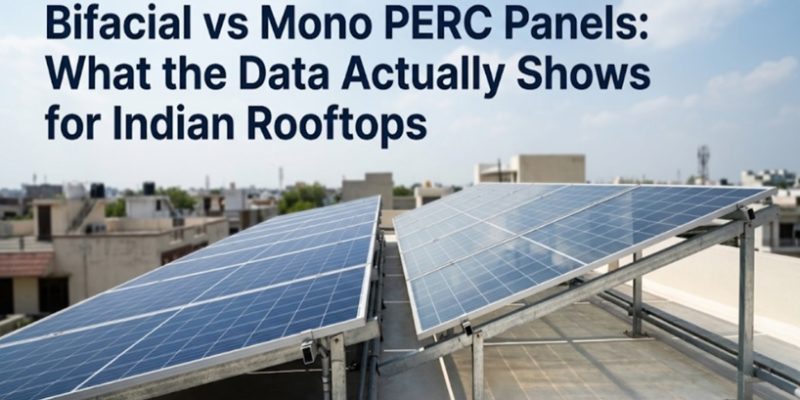
Mounting height matters just as much. Panels typically need to sit around 1 to 1.5 metres off the surface to give reflected light enough room to reach the rear face properly. On a lot of standard sloped, close-mounted Indian rooftops, this clearance simply isn’t there, which is honestly why the gain on residential rooftop solar panels tends to be more modest than the headline numbers suggest for ground-mounted utility installations.
Where Bifacial Panels Genuinely Shine
Ground-mounted systems installed over light coloured surfaces see the strongest results, and so do installations in snow-covered regions, where snow itself acts as a highly reflective surface during winter months. Agrivoltaic setups, where solar and farming share the same land, also benefit well from vertical bifacial orientations. Elevated installations like carports, parking structures, and industrial sheds tend to perform noticeably better too, simply because they naturally have the clearance bifacial panels need to work properly.
The Cost and Durability Side
Bifacial panels currently cost more upfront, roughly ₹38 to 55 per watt for the module alone in 2026, compared to mono PERC options. That said, their glass-on-glass construction tends to hold up better against potential induced degradation and micro-cracking, and many carry stronger warranties, often 12 to 25 years on the product itself with a 30-year linear performance warranty, a notch above what typical mono PERC panels offer.
For larger installations specifically, a 100 kWp bifacial system on a high albedo surface can effectively perform like a 115 to 125 kWp monofacial system, which translates to a meaningful reduction in the overall levelised cost of electricity over the system’s lifetime.
So Which Should You Actually Choose
If you’re installing on a standard residential rooftop with limited clearance and a dark or crowded surface, the honest answer is that mono PERC panels remain a perfectly solid, cost-effective choice, and roughly 80 percent of Indian homes still use them for good reason. Bifacial panels make far more financial sense when you have elevated mounting, a reflective surface beneath the array, or you’re working on a larger ground-mounted or commercial installation where the extra yield compounds significantly over 25 years.
Rather than choosing based on which technology sounds newer, it’s worth having an actual site assessment done first, checking your roof’s reflectivity, available clearance, and shading pattern before deciding.
Waaree offers both mono PERC and bifacial panel options, backed by decades of manufacturing experience and warranty support suited to Indian conditions, helping homeowners and businesses choose the technology that actually fits their specific rooftop rather than the one with the flashier spec sheet.