
 By
Getting screw length wrong is one of the easiest ways to create a roof that looks fine on day one but starts causing issues later. Too short and the fixing barely bites, which can lead to loosening under wind uplift. Too long and you can end up with awkward protrusion, poor seating, or a fixing that feels tight but isn’t actually doing the job properly. If you’re selecting roof screws, a simple “stack” approach makes length choice far more reliable than guessing, and it works whether you’re fixing into timber or steel.
The aim is not to overthink it. You just want enough length to pass through everything it needs to pass through, then achieve proper engagement in the substrate so the fixing stays stable over time.
Start With the Total Stack, Not the Sheet Alone
People often choose length based on the sheet thickness and forget the other layers that matter. In reality, your screw has to account for the full stack of materials it travels through before it can even begin to do its real job.
That stack usually includes the sheet profile itself, any washer or sealing arrangement, and then the substrate you’re fixing into. On a profile sheet, you also need to think about where you’re fixing: crest or valley, depending on the system. The profile height can be the biggest single factor in the length you need.
Once you view it as “total stack”, length selection becomes a practical calculation rather than guesswork.
Timber vs Steel: Engagement Is the Real Requirement
The key difference between fixing into timber and fixing into steel is how the screw achieves its hold.
With timber, you need enough thread embedded in the wood to resist pull-out and movement. If the screw only catches shallowly, it may hold initially but loosen over time as the roof moves and the timber expands and contracts. A reliable fixing depends on proper thread purchase in the timber, not just a screw that pokes through.
With steel, engagement is about forming a stable thread in the steel section without stripping. If the screw is too short, it may not form enough thread to hold properly. If it’s too long for the application, you can still get problems, especially if it encourages over-tightening or if the drill point struggles and overheats.
In both cases, length choice is really about making sure the screw has enough working thread where it matters.
Why “A Bit Longer Just In Case” Can Backfire
It’s tempting to add extra length for peace of mind, but longer isn’t automatically safer.
Excess length can mean more protrusion below the sheet line, which can be inconvenient or problematic depending on what’s underneath. It can also encourage people to over-drive the screw, because there’s more travel before it feels seated. Over-driving increases the chance of crushing washers, deforming sheet profiles, or stripping threads, all of which reduce long-term performance.
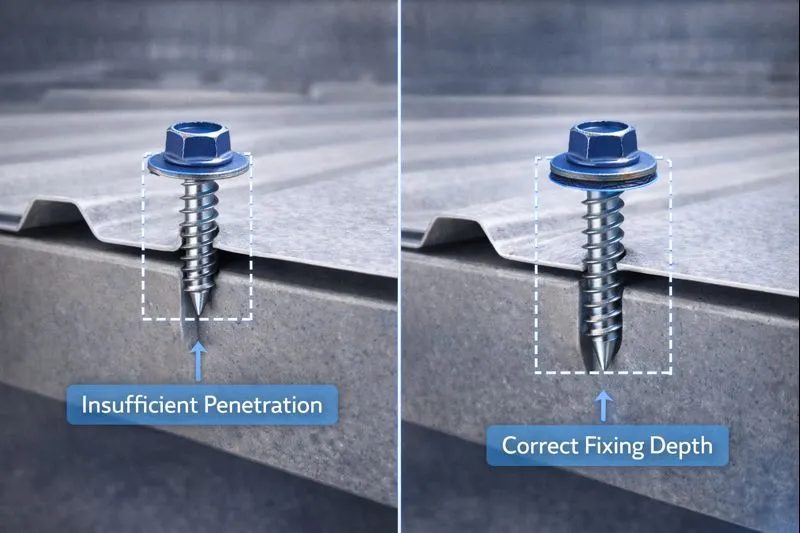
The best length is the one that gives reliable engagement without excess.
Profile Height and Fixing Position Make a Big Difference
On profile sheets, the height of the profile can be the difference between a screw that holds properly and one that barely engages. Fixing on the crest versus the valley changes the distance the screw has to travel before it reaches the substrate.
That means you should never choose length purely off the sheet thickness. Profile depth and fixing position are often the real drivers of length choice. This is also why two roofs using “sheet roofing” can need different lengths, even if the sheets look similar at a glance.
A Practical Way to Choose Length Without Overcomplicating It
A sensible approach is to work through it in order:
First, account for the sheet profile and where the screw will sit. Then allow for any washer and the need for proper seating. Finally, ensure you’re getting meaningful engagement in the substrate, whether that’s timber or steel.
If you think in those steps, you’re far less likely to end up with fixings that feel tight but don’t actually hold, or screws that are unnecessarily long and create their own issues.
Common Signs the Length Is Wrong
Length problems often show up in predictable ways.
If screws are too short, you may see movement, rattling in wind, or fixings that seem to loosen. You might also notice inconsistent “bite”, where some screws catch and others spin.
If screws are too long, you may see excessive protrusion, difficulty getting consistent seating, or over-compressed washers. In some cases, the extra length can make installation feel clumsy, which leads to more angled driving and uneven sealing.
These signs are useful because they point to the underlying issue quickly.
The Simple Takeaway
Choosing roof screw length is easier when you stop guessing and start thinking in stacks. Add up what the screw must pass through, then focus on proper engagement in the substrate. When the length is right, the fixing seats cleanly, holds firmly, and stays stable through weather and movement, which is exactly what you want from roof screws.